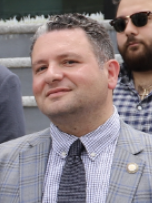
In a city where street safety is often framed as partisan, Morano made clear that protecting pedestrians and drivers is a shared interest:
“From my perspective this is not something that should be a partisan issue.
Where I live … I hear from constituents on almost a daily basis — drivers — the difficulty they have in seeing pedestrians or other cars because they have to inch into an intersection.”
Daylighting, which removes parking near corners to improve sightlines, is already standard in 44 states and widely recognized as a basic safety measure that prevents collisions. Morano emphasized precisely that:
“This is not an anti-driver bill. This is not an anti-car bill. This is a bill that supports public safety … This is not a radical idea.”
His comments came in support of Council Member Julie Won’s universal daylighting bill, Intro 1138, which has faced resistance from the Department of Transportation despite broad support across the Council.
A Common-Sense Safety Solution
The purpose of daylighting is straightforward: drivers need clear visibility at intersections. When large vehicles or tightly parked cars block the view of crosswalks, collisions become far more likely — especially involving pedestrians and cyclists. In our work as NYC car accident lawyers, we routinely see serious injuries caused by drivers forced to inch into traffic just to see what is coming.
Improving visibility is one of the most effective tools cities use to reduce crashes. Daylighting does not change traffic patterns, eliminate driving, or impose new burdens on motorists. It simply removes blind spots that place everyone at risk.
A Watered-Down Compromise Raises Questions
During the rally, additional news emerged: due to ongoing resistance from the DOT, the bill may be scaled back to apply only to streets near schools. While safeguarding children is essential, limiting a proven safety measure to a handful of blocks ignores the reality documented in crash data — severe injuries and fatalities occur citywide, not only near school zones.
If daylighting is effective enough to protect students, it is difficult to justify withholding those same protections from the general public.
Why This Matters to Crash Victims
Intersections are among the most dangerous locations for collisions in New York City. Reduced visibility is a major contributing factor in the pedestrian accidents we investigate, including cases resulting in catastrophic injury or death. When policies like universal daylighting stall, New Yorkers continue to face preventable risks.
As trial attorneys who have secured landmark results for crash victims — including some of the highest pedestrian-injury verdicts in New York — we understand firsthand how critical street-design decisions can be. Safety measures that improve visibility, reduce conflict points, and slow turning vehicles save lives. They also reduce the likelihood of drivers being involved in life-altering collisions.
When a Car Accident Causes Serious Injury, Legal Help Should Be Immediate
If you or a loved one has been injured in a traffic collision — whether as a pedestrian, cyclist, or motorist — it is important to speak with an experienced attorney promptly. Different rules may apply depending on the type of vehicle involved or whether the crash occurred at an intersection with obstructed visibility.
Our NYC car accident lawyers investigate intersection design, vehicle movement, visibility impairments, and compliance with traffic-safety measures to build strong cases for injured clients. We also stand ready to advocate for families who have suffered loss due to preventable design failures.
For guidance after a crash, contact us online or call us at 212-943-1090. for a free consultation