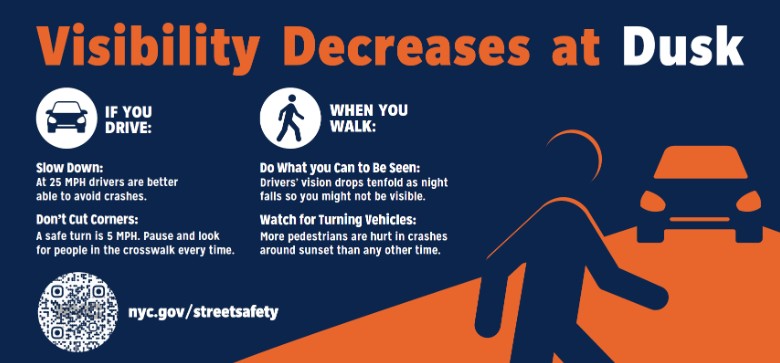
Why This Time of Year Is So Dangerous
According to city officials, the fall evening commute is one of the most dangerous periods of the year for pedestrians. When daylight ends earlier, visibility drops sharply during rush hour — just as streets are at their busiest.
This combination of darkness, fatigue, and heavy traffic leads to a spike in serious and fatal crashes.
For motorists, pedestrians, and cyclists, that means:
- Drivers must slow down and stay alert as visibility fades.
- Pedestrians must assume drivers may not see them clearly and use crosswalks whenever possible.
- Cyclists must ride predictably and make themselves visible with lights or reflective gear.
When crashes occur under these conditions, reduced lighting and driver reaction times often become critical factors in determining fault and liability.
What the City’s Campaign Includes
The Dusk & Darkness initiative, first launched in 2016, combines public awareness, targeted enforcement, and driver education to reduce traffic fatalities during this high-risk period.
Key components include:
- Day of Awareness: DOT and NYPD Vision Zero teams are engaging with communities citywide to remind commuters about the increased risk of fall evening crashes.
- Increased Enforcement: The NYPD is stepping up evening and overnight patrols to target hazardous behaviors such as speeding, distracted driving, red-light violations, and failure to yield to pedestrians.
- Driver Education: Agencies are encouraging all drivers to adjust to reduced visibility by following the 25-mph citywide speed limit, turning carefully, and yielding to pedestrians and cyclists.
- Taxi & For-Hire Vehicle Outreach: The Taxi & Limousine Commission is reminding professional drivers to slow down and remain alert during dusk and nighttime hours.
What It Means From a Legal Perspective
As New York car accident attorneys, we often see how conditions like low light, poor visibility, and driver inattention lead to catastrophic injuries. The Dusk & Darkness campaign reinforces what we already know through our cases: drivers have a legal duty to adapt their behavior to road and lighting conditions.
Key legal implications include:
- Failure to yield or speeding at dusk can establish negligence if a pedestrian is knocked down or a cyclist is struck.
- Reduced visibility may explain how an accident occurred but does not excuse a driver’s obligation to drive safely.
- Distracted driving and inadequate headlights or vehicle maintenance can heighten a driver’s liability.
- Citywide recognition of this risk through the Vision Zero campaign further demonstrates that drivers are on notice about these dangers.
When visibility decreases, a driver’s duty of care increases. Failure to adapt—whether by slowing down, turning cautiously, or keeping headlights on—can be the difference between safety and tragedy.
Safety Tips for Drivers and Pedestrians
For Drivers:
- Slow down and anticipate reduced visibility.
- Turn on headlights before dark to help others see you.
- Eliminate distractions such as phones or in-vehicle screens.
- Watch for pedestrians and cyclists, especially at intersections.
- Avoid double-parking or blocking crosswalks, which can obscure sightlines.
- Ensure your vehicle’s lights, wipers, and brakes are functioning properly.
For Pedestrians and Cyclists:
- Wear reflective or light-colored clothing and use bike lights.
- Cross streets at marked intersections whenever possible.
- Avoid distractions when crossing — stay alert to your surroundings.
- Make eye contact with drivers before stepping into the roadway.
- Be aware that vehicles may approach faster than they appear in dim light.
If You Are Injured in a Dusk or Nighttime Crash
If you or a loved one are struck by a vehicle during dusk or early evening hours, act quickly:
- Seek medical attention immediately.
- Document the conditions — note lighting, weather, visibility, and time of day.
- Take photos of the intersection, traffic signals, and any obstructions.
- Identify witnesses and request police reports or surveillance footage.
- Contact an experienced car accident attorney as soon as possible.
Our firm has extensive experience representing pedestrians, cyclists and motorists injured during low-visibility conditions. We know how to analyze lighting, timing, and driver behavior to establish fault and secure full compensation for our clients.
A Final Word
The message from this year’s Vision Zero “Dusk & Darkness” campaign is simple but urgent: when the sun goes down, risks go up.
Drivers must slow down and stay alert, while pedestrians and cyclists must take extra precautions to remain visible.
If you’ve been injured in a crash that occurred during dusk or evening hours, contact the New York City car accident attorneys at Gair, Gair, Conason, Rubinowitz, Bloom, Hershenhorn, Steigman & Mackauf for a free consultation. Our firm has recovered billions for accident victims across New York and continues to fight for safer streets for all.
Picture: Dusk and Darkness tips being distributed today to drivers and pedestrians. NYC DOT