 New York Personal Injury Attorneys Blog
What a Neurosurgeon’s Warning About Self-Driving Cars Means for New York Drivers and Crash Victims


 On December 2, 2025, The New York Times published a compelling guest essay by neurosurgeon Dr. Jonathan Slotkin, titled “The Data on Self-Driving Cars Is Clear. We Have to Change Course.” In it, he describes what he sees every day in trauma units: catastrophic injuries from motor vehicle crashes that no amount of surgical skill can reverse. His perspective is not theoretical or technological — it is medical, urgent, and grounded in human outcomes.
As New York car accident lawyers representing victims of severe crashes, the data and warnings he highlights are deeply relevant to the families we serve.
A Doctor’s View From the Trauma Bay
Dr. Slotkin begins with a case that is all too familiar to those of us who litigate fatal and catastrophic crash cases: a rollover accident involving a teenager who was ejected from the vehicle. Despite emergency surgery, the young victim was declared brain dead. Cases like these illustrate the reality behind crash statistics — that the forces involved in high-energy collisions often leave survivors with life-altering spinal cord injuries, brain injuries, paralysis, or death.
According to his article, more than 39,000 Americans died in motor vehicle crashes last year, and 10,000 crash victims arrive in emergency rooms every day. Motor vehicle collisions remain a leading cause of spinal cord injury and a top cause of death for children and young adults.
These are the kinds of tragedies that our attorneys confront regularly in the courtroom and during investigations. Every data point represents a client, a family, a life permanently altered.
The Waymo Data: Promising, But Only One Part of the Picture
A major theme of Dr. Slotkin’s essay is the safety data recently released by Waymo, the autonomous vehicle company, covering nearly 100 million driverless miles. According to his analysis:
-
91% fewer serious-injury-or-worse crashes
-
80% fewer crashes causing any injury
-
96% fewer injury-causing crashes at intersections
-
92% fewer crashes involving pedestrians
-
83% fewer crashes involving cyclists or motorcyclists
If accurate and broadly replicable, these reductions represent extraordinary potential.
But there is an important caveat: Waymo is the only company providing complete, independently analyzable data. Other companies — including those already deploying automated systems on public roads — do not.
For New Yorkers, transparency matters. Without complete crash, mileage, and location data from all autonomous and semi-autonomous vehicle manufacturers, it is impossible to fully understand the risks these systems pose or the protections that should be implemented.
Why These Findings Matter for New York Crash Victims
Dr. Slotkin emphasizes that even a 30% integration of fully automated vehicles could prevent 40% of crashes. Yet he also notes important limitations:
-
Most “autonomous” systems on the road today are driver-assistance technologies, not true self-driving vehicles.
-
Research on partial automation systems, including those used by Tesla, remains inconclusive or inconsistent.
-
Some of the widely publicized crashes involving autonomous vehicles stem from human drivers striking those vehicles — but victims, including pedestrians, still suffer the consequences.
-
Self-driving vehicles currently operate only in specific cities and controlled environments.
From a legal standpoint, these distinctions matter enormously. Determining who is responsible — the human driver, the vehicle manufacturer, a software system, or a combination — is often complex. Victims deserve access to every piece of data needed to prove what happened.
Autonomous Vehicles Will Not Meaningfully Reduce Injury Risk Without Policy Reform
One of the strongest points in Dr. Slotkin’s essay is his warning that America is not prepared for the transition to autonomous mobility. Federal regulations do not require companies to report miles driven or crash rates — only crashes themselves.
This is inadequate. As he notes, safety requires the denominator, not just the numerator.
For victims and their attorneys, this lack of transparency means:
-
Manufacturers may possess critical information about system risks that the public never sees.
-
Police reports and crash reconstructions may be incomplete without technical data.
-
Injured pedestrians, cyclists, and motorists may struggle to obtain evidence needed to prove fault.
-
Insurance companies may attempt to shift responsibility away from autonomous systems.
Our attorneys have already seen firsthand how manufacturers resist releasing internal data, even when victims are seriously injured. Any national transition to autonomous vehicles must include strict reporting standards, independent auditing, and clear liability frameworks.Even With Technological Advances, Human Drivers Still Cause the Majority of Crashes
The vast majority of cases our firm handles involve human error: speeding, distraction, drunk driving, reckless lane changes, and failure to yield at intersections. Dr. Slotkin’s analysis underscores this reality.
In the limited autonomous-vehicle crashes reviewed:
-
A human driver ran a red light.
-
A human driver caused a high-speed chain-reaction crash.
-
A human motorcyclist rear-ended a Waymo vehicle, then was fatally struck by a hit-and-run driver.
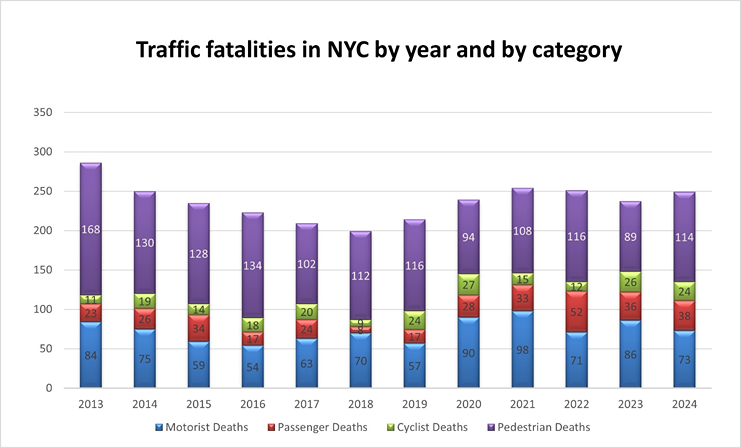
These scenarios mirror millions of crashes nationwide — including in New York City — where pedestrians, cyclists, motorcyclists, and passengers are the ones who pay the price for another driver’s negligence.
What New York Crash Victims Should Know Right Now
Even if autonomous vehicles ultimately reduce crashes, New Yorkers today remain vulnerable to:
-
Speeding and reckless driving
-
Uber, Lyft, and taxi crashes
-
Commercial vehicle and truck collisions
-
Drunk or impaired drivers
-
Intersection and pedestrian impacts
-
Dangerous road conditions
-
Defective or improperly maintained vehicles
When injuries occur, victims need immediate representation from attorneys who understand both the traditional causes of crashes and emerging liability issues involving new vehicle technologies.
Our work involves:
-
Detailed accident reconstruction
-
Obtaining and interpreting vehicle-generated data
-
Identifying all responsible parties
-
Working with medical and biomechanical experts
-
Pursuing full compensation for medical care, lost income, and long-term needs
Whether a case involves a human driver, a rideshare vehicle, or advanced driver-assistance technology, the legal analysis must be thorough and precise.
A Safer Future Requires Both Innovation and Accountability
Dr. Slotkin’s message is ultimately one of urgency: the nation suffers staggering losses from preventable crashes, and autonomous travel may significantly reduce that harm. But only if implementation is transparent, carefully regulated, and guided by public-health priorities rather than industry timelines.
For now, human drivers remain responsible for virtually all serious crashes in New York. And when negligence leads to life-changing injuries, victims have the right to hold every responsible party accountable — whether that is a driver, a vehicle manufacturer, a software developer, or a corporate operator.
Our New York car accident lawyers will continue to advocate for the people harmed today while staying at the forefront of technological and regulatory developments that will shape roadway safety for decades to come.
