 New York Personal Injury Attorneys Blog
Our NYC Car Accident Lawyers Respond to the Relaunch of the Streets Plan Under Mayor Zohran Mamdani


New York City’s streets are once again at the center of public policy. At a February 13 press conference, Mayor Zohran Mamdani announced the relaunch of the Streets Master Plan, originally enacted by the City Council in 2019 to require measurable progress on bike lanes, bus lanes, and pedestrian infrastructure. The plan had stalled under former Mayor Eric Adams. Now, the new administration has pledged to restore coordination between agencies and bring the city closer to its Vision Zero goals.
From the perspective of experienced NYC car accident lawyers, this is more than a transportation story. It is a public safety issue with direct consequences for injury victims and their families.
Why the Streets Plan Matters in Car and Truck Accident Litigation
Every serious crash tells a story about design.
In many of the car, truck, pedestrian and bicycle accident cases our firm handles, roadway configuration plays a central role:
-
Intersections without hardened pedestrian space
-
School zones lacking traffic-calming infrastructure
-
Bike lanes that abruptly end, forcing cyclists into moving traffic
-
Bus lanes that are unprotected and inconsistently enforced
-
Poor visibility at parking garage exits
-
Failure to implement known safety improvements
When infrastructure falls short of established safety standards, preventable crashes follow.
If the Streets Plan is fully implemented, it could significantly reduce the types of collisions that routinely lead to catastrophic injuries — including wrongful death, traumatic brain injury, spinal cord injury, and complex orthopedic trauma.
Sammy’s Law and 20 MPH School Zones
Transportation advocates have urged the city to implement “Sammy’s Law” by establishing 20 mph zones around schools, with hardened gateways and traffic-calming measures within a half-mile radius.
From a liability standpoint, school-zone crashes are among the most devastating cases we see. Children have limited capacity to anticipate vehicle behavior. Slower speeds dramatically reduce both crash likelihood and injury severity.
When municipalities fail to implement legally authorized safety measures, injured families may explore whether the City’s inaction contributed to the harm.
Protected Bike Lanes and Civil Responsibility
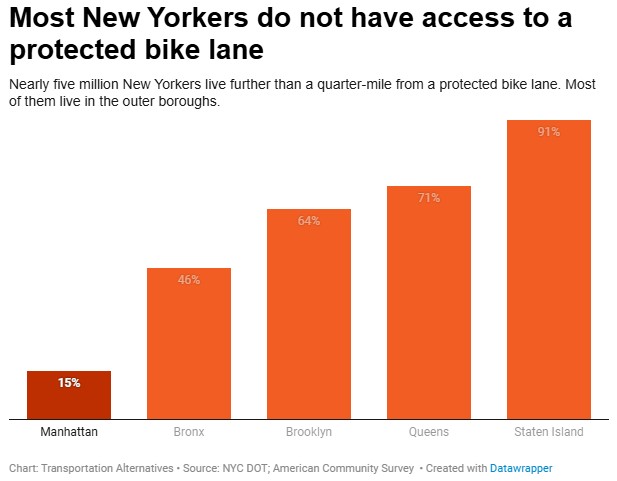 Transportation Alternatives reports that nearly five million New Yorkers live more than a quarter mile from a protected bike lane, with the highest gaps in the outer boroughs.
Disconnected bike lanes create predictable risk:
-
Cyclists are forced into mixed traffic
-
Drivers encounter unexpected merges
-
Delivery trucks obstruct unprotected lanes
-
Right-hook and dooring crashes increase
In bicycle accident litigation, roadway design often becomes a central evidentiary issue. A connected, hardened bike network reduces ambiguity — and reduces crashes.
Meeting Legal Requirements Is Not Optional
The Streets Plan is law. It contains numeric metrics for mileage, reporting, and planning.
When legally mandated safety improvements are delayed or disregarded, it raises serious questions:
-
Was the City on notice of a dangerous condition?
-
Were corrective measures required but not implemented?
-
Did prior crash data demonstrate a pattern?
-
Were budgetary or political decisions prioritized over safety compliance?
These are not abstract policy debates. They become real questions in courtroom litigation after someone is seriously injured.
Outcome Targets: A Shift Toward Measurable Safety
Advocates have called for measurable outcome goals, including:
-
Increased daily bike ridership
-
Improved bus speeds
-
Reduced vehicle miles traveled
-
Lower transportation-related pollution
-
Increased pedestrian plaza usage
From a legal perspective, measurable outcomes create clearer benchmarks. When targets exist, deviations become identifiable. When safety goals are documented, failure to meet them can carry consequences.
Civil Claims After a NYC Car or Truck Crash
While criminal charges may follow certain collisions, most injured victims must pursue civil claims to obtain compensation for:
-
Medical expenses
-
Lost income
-
Rehabilitation and long-term care
-
Pain and suffering
-
Loss of consortium
-
Wrongful death damages
In cases involving municipal negligence, strict notice requirements apply. Claims against the City of New York often require service of a Notice of Claim within 90 days. Missing that deadline can bar recovery entirely.
Safer Streets Reduce Litigation — But Until Then, Accountability Matters
We support evidence-based safety improvements. Fewer crashes mean fewer families facing devastating loss.
However, when streets remain dangerous, and when preventable collisions occur, victims deserve strong legal representation to hold negligent drivers — and when appropriate, negligent entities — accountable.
If you or a loved one has been injured in a New York City car, truck, pedestrian, or bicycle crash, prompt legal consultation is essential to protect your rights.
For a free consultation with experienced NYC car accident lawyers, call 212-943-1090.
Safer streets are the goal. Accountability is the safeguard.
