 New York Personal Injury Attorneys Blog
Ben Rubinowitz and Evan Torgan Publish New York Law Journal Article on Connecting Voir Dire to Final Argument


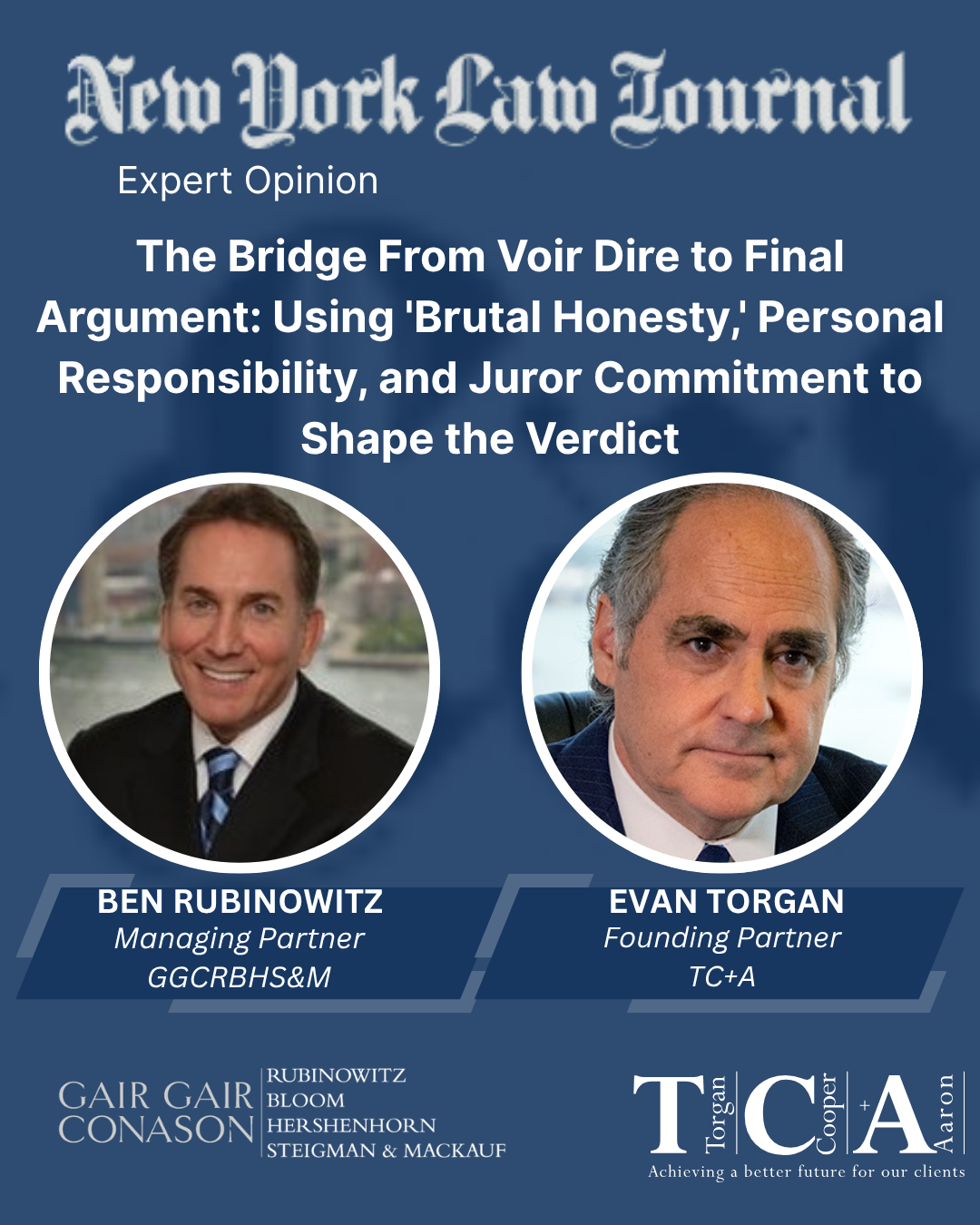 Managing Partner Ben B. Rubinowitz of Gair, Gair, Conason, Rubinowitz, Bloom, Hershenhorn, Steigman & Mackauf and trial attorney Evan Torgan of Torgan, Cooper + Aaron have published a new article in the New York Law Journal titled:
The article examines one of the most important but often overlooked aspects of trial advocacy: the idea that persuasive advocacy begins during jury selection, not during opening statements.
Drawing from real courtroom strategy and juror psychology, Rubinowitz and Torgan explain how effective trial lawyers use voir dire to identify the values, beliefs, and life experiences that will ultimately influence deliberations. Rather than treating jury selection as a procedural exercise, the article demonstrates how skilled advocates build a consistent narrative that carries from voir dire through summation.
A central theme of the article is the concept of asking jurors for “brutal honesty” during voir dire. According to the authors, this approach creates authenticity in the courtroom and encourages jurors to openly discuss their beliefs regarding accountability, fairness, safety, and personal responsibility.
The article also explores how both plaintiffs and defendants can effectively frame cases around the same core principle: personal responsibility. Using a construction accident hypothetical involving a cluttered worksite and a fall from a ladder, the authors show how each side can present responsibility differently depending on the facts and perspective of the case.
Rubinowitz and Torgan further discuss the strategic use of scaled questioning during voir dire, encouraging jurors to publicly commit themselves to principles involving accountability and shared responsibility. These commitments can later become powerful tools during summation because jurors are more likely to embrace concepts they themselves articulated during jury selection.
The article reinforces an advocacy philosophy long associated with Ben Rubinowitz and the trial attorneys at Gair, Gair, Conason, Rubinowitz, Bloom, Hershenhorn, Steigman & Mackauf: successful trial advocacy requires more than presenting facts. It requires connecting evidence to the values jurors already believe are important, including honesty, fairness, accountability, and common sense.
For more than 100 years, the attorneys at Gair, Gair, Conason, Rubinowitz, Bloom, Hershenhorn, Steigman & Mackauf have represented victims in the most serious personal injury, medical malpractice, construction accident, and wrongful death cases throughout New York City and New York State.
Free Consultation: 212-943-1090
