Gair, Gair, Conason, Rubinowitz, Bloom, Hershenhorn, Steigman & Mackauf is a New York Plaintiff's personal injury law firm specializing in automobile accidents, construction accidents, medical malpractice, products liability, police misconduct and all types of New York personal injury litigation.

Articles Posted in Hospital Negligence

Published on:

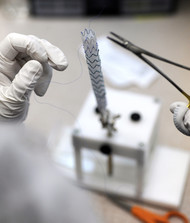
stent.jpgMedical Malpractice related to Cath Lab procedures are on the rise as overuse of Cardiac Stents lead to an increase of deaths linked to this type of procedure.

In a recent article on Bloomberg, Sydney P. Freedberg, describes the shocking extreme the administrators at Satilla Regional Medical Center in Waycross, Georgia went to in order to keep their cath lab operating and producing revenue.

Because of its remote location, the hospital was unable to attract competent cardiovascular surgeons. In order to keep their cath lab running the administrators paid an extravagant salary to a non qualified surgeon, Dr. Azmat whose only experience with cardiac stents was a two weekend course experimenting on cadavers and pigs.

Published on:

Most Surgical Fires result from Medical Malpractice or negligence causing serious injury, disfigurement, and even death. They occur in, on or around a patient who is undergoing a surgical procedure. An estimated 550 to 650 surgical fires occur in the United States per year. Despite the fact that the root causes of surgical fires are well-understood, surgical fires still occur.

To promote actions to reduce the risk of risk of surgical fires.The Preventing Surgical Fires Initiative is celebrating its second anniversary during National Fire Prevention Week, October 6-12, 2013.

Fires happen during surgery because the 3 elements needed to start a fire (fire triangle) are present in an operating room:

Published on:

The number of deaths resulting from Medical Errors in Hospitals have been grossly underestimated according to new estimates developed by John T. James, a toxicologist at NASA’s space center in Houston. James runs an advocacy organization called Patient Safety America that he created after his 19 year old son died as a result of medical malpractice in a Texas Hospital.

In 1999, “To Err is Human Report”, estimated the number of deaths resulting from medical errors in hospitals at 98,000. In 2010, The Office of the Inspector General for Health and Human Services said that bad hospital care contributed to the deaths of 180,000 in Medicare patients alone in a given year.

According to the study published in the current issue of “Journal of Patient Safety” these numbers are too low and the true number of premature deaths associated with preventable harm to patients is estimated at more than 400,000 per year.

Published on:

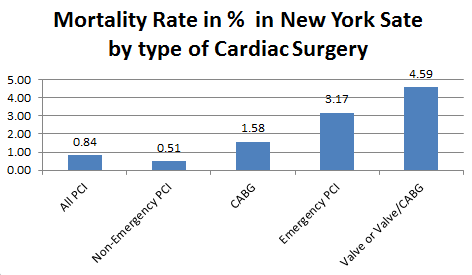
New data from New York DOH unveil mortality rates for cardiac surgery by hospitals and by type of procedure. Even though some procedures are by nature riskier than others, New Yorkers suffering from heart conditions should understand that not every hospital offers the same level of safety.

Based on the data provided by The New York State Health Department here are some of the findings:

Valve surgery is the riskiest type of cardiac surgery with a mortality rate of 4.59% for New York State between 2008 and 2010. PCI or Percutaneous Coronary Intervention, sometimes also called coronary angioplasty or coronary stenting is the less risky of all types of cardiac surgeries as long as it is a planned surgery. It becomes riskier when it is an emergency procedure.

Mortality%20rate%20in%20New%20York%20Cardiac%20Surgery.png

The following graphs show the mortality rate by hospital for the various type of procedures. Because some hospitals may deal with riskier cases than others the graphs show 3 types of mortality rates:
Continue reading →

Published on:

Complications during or after surgery are happening too often at New York City, St Luke’s Hospital. The Hospital scored a low overall surgery rating on the new Consumer Reports surgery safety rating. The safest hospitals in the city to have surgery are Mount Sinai, NYU Langone Medical Center and New York Presbyterian Hospital.

Consumer Reports looked at medicare claims data from 2009 through 2011 for patients undergoing 27 categories of common scheduled surgeries. For each hospital, the results for all procedures are combined into an overall surgery rating.The global ranking is based on who died in the hospital or stayed longer than expected for their procedure. More detail by type of surgery as well as a hospital ranking by state can be found on the Consumer Reports website.

Most common surgery complications are bad reaction to anesthesia, heart problems or surgeon nicking a blood vessel, leaving an instrument inside, or even operating on the wrong body part. Complications can also happen after the surgery. Nationally, 30 percent of patients suffer infections, heart attacks, strokes, or other complications after surgery and sometimes even die as a result.

Published on:

Doctors should be vigilant when they decide to send home some pediatric cancer patients who still need to use a central venous catheter for their treatment. Because the central line is a tube that is placed directly into a major blood vessel, it can easily become a gateway for bacteria in the blood stream if it is not handled properly. Central line-associated bloodstream infections (CLABSIs) can lead to serious personal injury such as organ damage and sometimes death.

A recent study from Johns Hopkins Children’s Center published yesterday in the journal Pediatric Blood & Cancer followed 319 children with cancer between 2009 and 2010. Most children were first treated in the hospital and then sent home to continue their treatment. 19 children developed a central line-associated bloodstream infection (CLABSI) while hospitalized and 55 while at home.

Hospitals have been fighting for a long time against bloodstream infections and they have made serious progress in reducing them. They have experienced clinicians following precise protocols.Things are different when children are treated at home by family members. More should be done in preventing development of CLABSIs at home.For example teaching family members how to handle and clean central lines should be part of the formal discharge protocol. It is not the case yet.

Published on:

Gross Medical Malpractice related to blood transfusion seems to occur again at Coney Island Hospital in Brooklyn, New York. According to the New York Post, the hospital blood lab was shut down yesterday after a 40 year old man died following a botched transfusion in which he was given blood that had been mislabeled by a lab technician. Today the Daily News reports that an 86 year old lady died after she was given the wrong type of blood on June 9th, just a month ago.

According to statistics the probability for a patient to receive the wrong type of blood is one out of every 14,000 transfusion.

Coney Island Hospital has a history of serious malpractice in handling blood. From 1990 to 1994 the hospital recorded five nonfatal transfusion mistakes. In 1995 , Ira Medjuck , a 30 year old paramedic, agonized for a month before her death after she was given a botched blood transfusion.

Published on:

A 2004 landmark study found that medical interns working a 24-hour shift in ICU committed 36 percent more serious medical errors than when they worked 16 hours. This study started the debate that lead to the creation in 2011 of a new rule that required the maximum allowable shift for medical interns to change from 30 straight hours to 16. This rule created a lot of controversy in the medical world and some recent studies question the real benefit of shorter shifts for interns.

In her new article Sandra G. Boodman from the Washington Post gives a detailed overview of the situation then and now.

Published on:

Alarm fatigue happens when medical workers overwhelmed by constant and loud alarm rings turn down the volume on the devices, shut them off or simply ignore them. These actions can lead to serious personal injury or wrongful death.

As hospitals invest in more and more sophisticated equipment to save lives, nurses and other hospital workers especially in Intensive Care Units have to deal with the constant and sometimes very loud ringing of alarms during their shift. A recent study estimated that the average number of alarms that sounded per bed per day in one ICU was 771. This is obviously more than staff and patients can take and hospitals have to make a priority of reviewing their alarm system or they may risk loss of their accreditation.

In a very interesting article, Lena H. Sun from the Washington Post, gives an overview of recent Medical Malpractice cases related to Alarm Fatigue and what measures are being taken by hospitals to address this growing medical concern.

Published on:

The Bronx collaborative, a group of hospital and medical insurers demonstrated in a study that patients who were participating in a special program to manage transition between hospital and home were less likely to be re-admitted to hospitals than patients who received the current standard care.

Medical problems that lead to hospital re-admissions can often be prevented by personal contacts with patients before and after their discharge. Intensive pre-discharge education, post discharge follow up appointment with the physician and phone calls to review medication and discuss concerns are significantly lowering the re-admission rate and improving patient satisfaction.