 New York Personal Injury Attorneys Blog
Minimum Safety Standards vs. Reasonable Care: Why “Barely Passing” May Not Be Enough


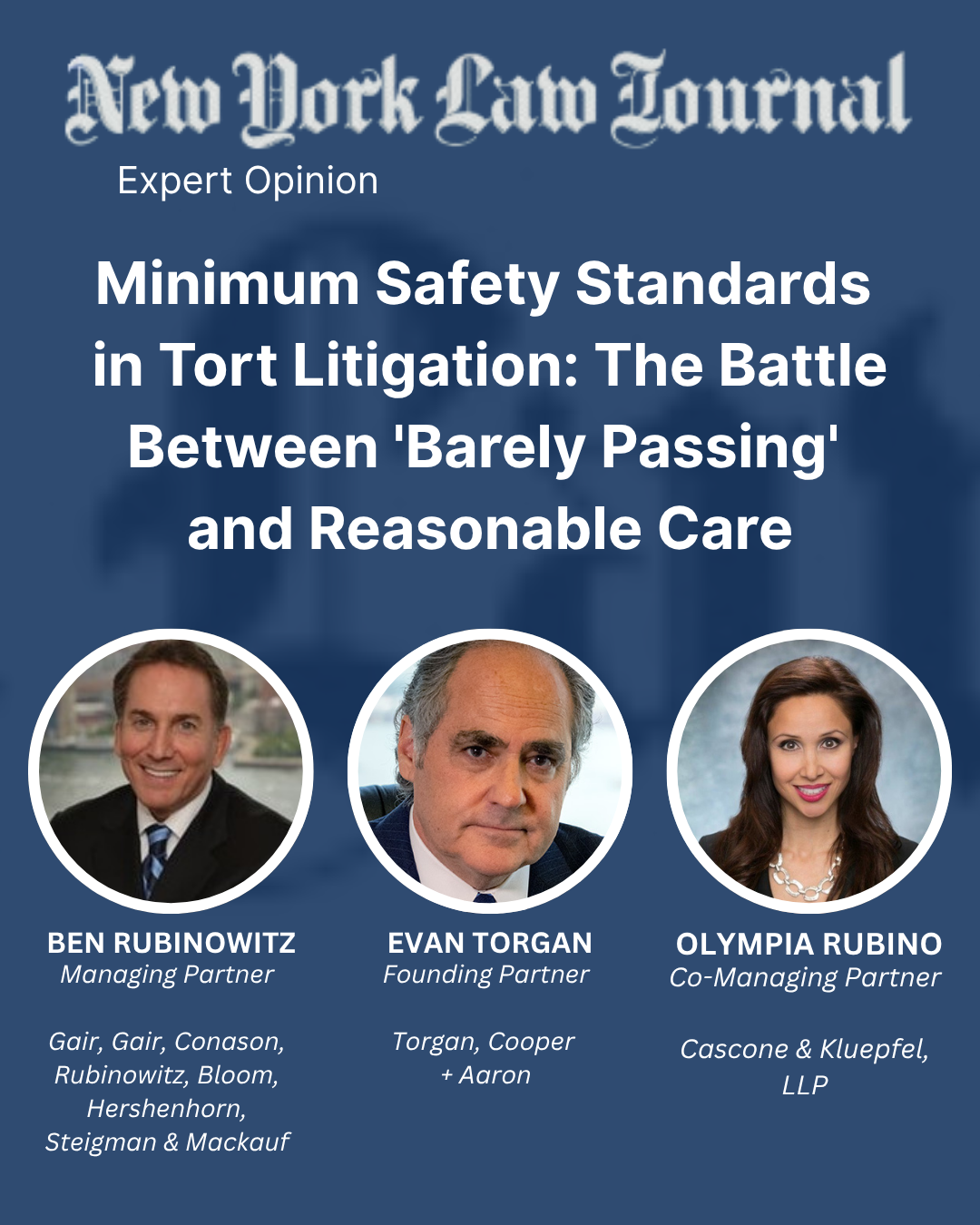 A newly published article in the New York Law Journal examines one of the most important and frequently misunderstood concepts in negligence law: the distinction between minimum safety standards and reasonable care.
In “Minimum Safety Standards in Tort Litigation: The Battle Between ‘Barely Passing’ and Reasonable Care,” authors Ben Rubinowitz, Evan Torgan, and Olympia Rubino explore how codes, regulations, and professional standards are viewed differently by plaintiffs and defendants in tort cases.
Virtually every negligence case involves safety standards. Building codes, OSHA regulations, ANSI standards, and accepted medical practices establish objective benchmarks intended to protect people from foreseeable harm. Yet an important question remains: does complying with those standards necessarily mean that reasonable care has been exercised?
From the plaintiff’s perspective, these rules represent the minimum acceptable level of conduct. They establish the floor,not the ceiling. Human safety, they argue, deserves more than a bare minimum effort.
One powerful analogy discussed in the article compares minimum standards to a student earning a D+. Technically, the student passed. But would anyone celebrate barely passing? Similarly, plaintiffs often argue that when lives are at stake, simply doing the minimum may not be enough.
Defense counsel view the issue differently. They argue that negligence law requires reasonable care, not perfection, excellence, or extraordinary precaution. The focus, they contend, should not be on what could have been done in hindsight, but rather on whether the defendant acted reasonably under the circumstances existing before the accident occurred.
Ultimately, both sides present compelling narratives. Plaintiffs ask why “barely passing” should be considered good enough when safety is involved. Defendants caution against transforming negligence law into an ever-expanding duty to do more.
As the article explains, the tension between these competing viewpoints often determines the outcome of negligence cases involving construction accidents, medical malpractice, premises liability, transportation disasters, and defective products.
The article was authored by Ben Rubinowitz, Managing Partner of Gair, Gair, Conason, Rubinowitz, Bloom, Hershenhorn, Steigman & Mackauf, together with Evan Torgan of Torgan Cooper + Aaron, PC, and Olympia Rubino, Co-Managing Partner of Cascone & Kluepfel.
Their discussion highlights one of the enduring questions in tort law: when safety matters most, is merely “barely passing” enough?
