 New York Personal Injury Attorneys Blog
Ben Rubinowitz and Evan Torgan Publish New York Law Journal Article on Persuading Juries in Serious Injury Cases Involving Elderly Plaintiffs


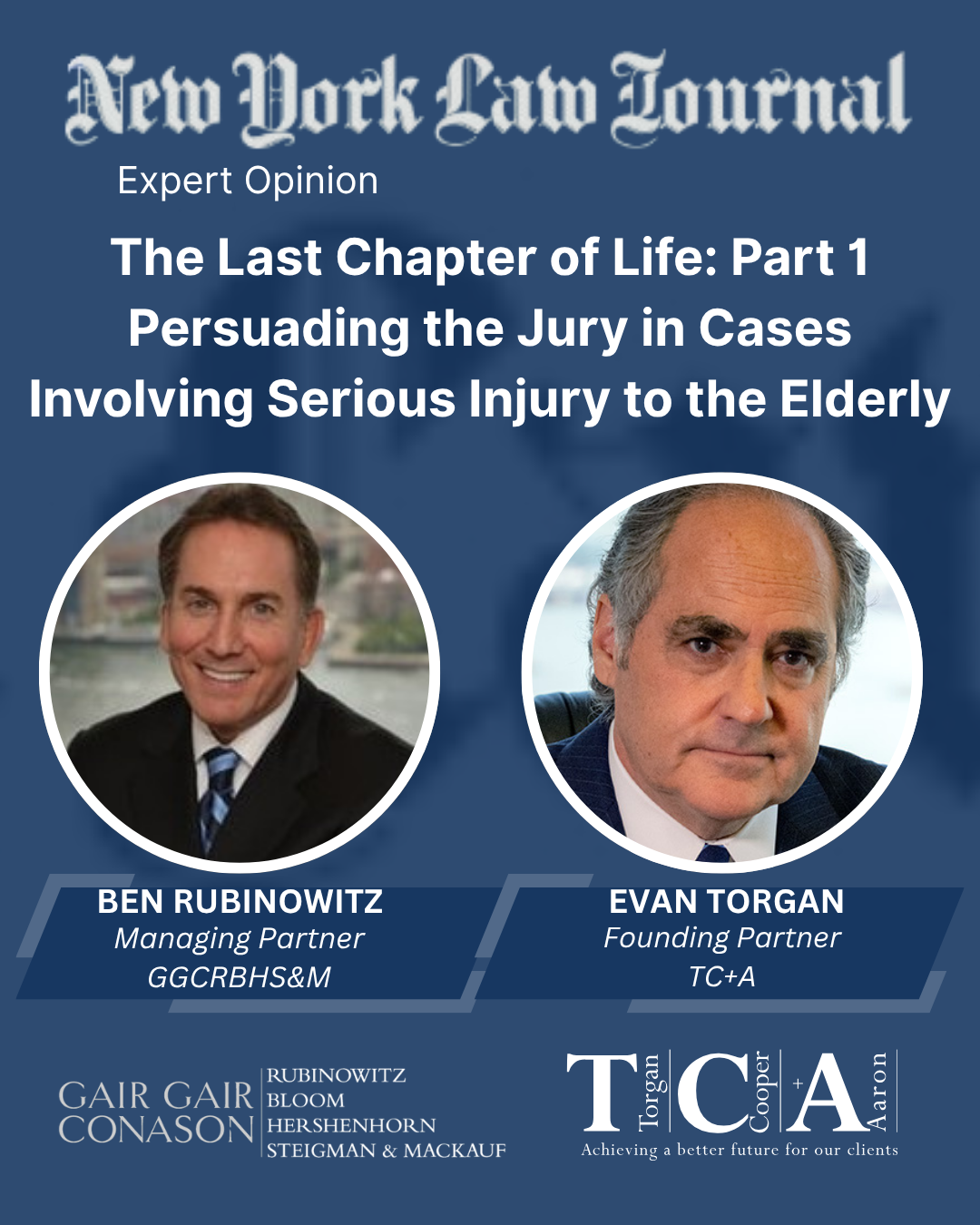 Ben B. Rubinowitz, Managing Partner of Gair, Gair, Conason, Rubinowitz, Bloom, Hershenhorn, Steigman & Mackauf, and Evan Torgan, Senior Partner at Torgan Cooper & Aaron, have co-authored a new article published in the New York Law Journal titled, “The Last Chapter of Life: Part 1—Persuading the Jury in Cases Involving Serious Injury to the Elderly.”
The article examines one of the most difficult challenges facing trial lawyers: ensuring that elderly injury victims receive full and fair compensation despite the common misconception that advancing age somehow diminishes the value of their losses.
Challenging Age Bias in the Courtroom
Rubinowitz and Torgan explain that defense attorneys often emphasize a plaintiff’s age, preexisting medical conditions, or statistical life expectancy in an effort to minimize damages. Rather than disputing the realities of aging, they argue that plaintiff’s counsel should redirect the jury’s attention to the true issue:
What did the defendant’s negligence actually take away?
The authors emphasize that every individual, regardless of age, has the same legal right to live free from the consequences of another person’s negligence. Whether someone has fifty years remaining or five, the law does not discount the value of those years simply because they occur later in life.
The Final Chapter of Life Has Extraordinary Value
A central theme of the article is that retirement and later life often represent the years people have spent decades working toward.
Rather than viewing aging as a period of decline, Rubinowitz and Torgan describe it as a time when people finally have the opportunity to enjoy:
- Time with grandchildren
- Travel
- Long-awaited hobbies
- Lifelong friendships
- Family traditions
- The independence earned through a lifetime of work
When a catastrophic injury suddenly destroys those opportunities, the loss extends far beyond medical bills or physical injuries. The true harm is measured by the loss of dignity, independence, relationships, and the ability to enjoy life’s final chapter.
Aging Is Natural, Catastrophic Injury Is Not
The article draws an important distinction between the gradual changes that accompany aging and the sudden devastation caused by negligence.
People naturally adapt over time to the physical effects of growing older. Negligence, however, compresses years of anticipated change into a single traumatic event.
An individual who was independently shopping, driving, traveling, or spending time with family one day may suddenly require assistance with everyday activities the next. According to the authors, that abrupt loss, not chronological age, is what juries should evaluate when determining damages.
Looking Beyond Medical Records
Rubinowitz and Torgan caution attorneys against allowing medical records to define an elderly plaintiff.
Medical charts document diagnoses, but they rarely tell the story of a person’s life.
They do not reveal:
- Weekly breakfasts with lifelong friends
- Attending grandchildren’s school events
- Gardening
- Walking a favorite dog
- Cooking family holiday meals
- Enjoying evening walks with a spouse
The article encourages trial lawyers to present the full human story of their clients rather than allowing jurors to see only a list of medical conditions.
The Greatest Loss Is Often Independence
According to Rubinowitz and Torgan, one of the most profound injuries suffered by many elderly plaintiffs is not physical pain, it is the loss of independence.
Simple daily activities such as driving to visit a friend, preparing a favorite meal, attending religious services, or taking an evening walk become impossible after a catastrophic injury. These losses affect not only physical abilities but also personal identity, family relationships, and emotional well-being.
Asking Jurors the Right Questions
The authors conclude that successful advocacy requires shifting the jury’s focus away from questions such as:
- How old was the plaintiff?
- How many years remained?
Instead, jurors should consider:
- What has this person actually lost?
- What independence can never be restored?
- Which family traditions and relationships have been permanently changed?
- What hopes and plans for the future disappeared because of the injury?
By reframing the discussion around these questions, attorneys can help jurors understand the full human impact of catastrophic injuries suffered later in life.
Continuing a Tradition of Trial Advocacy Leadership
Ben B. Rubinowitz has long been recognized as one of the nation’s leading trial lawyers and regularly contributes to the legal profession through lectures and scholarly publications on trial advocacy. Together with Evan Torgan, a nationally respected trial attorney and fellow member of the prestigious Inner Circle of Advocates, this latest New York Law Journal article offers valuable guidance for lawyers handling serious injury cases involving elderly plaintiffs.
Their message is clear: the value of a person’s life is not measured by age, but by what negligence has taken away. As the authors explain, the jury’s task is not to count birthdays, it is to determine the true value of the dignity, independence, relationships, and quality of life that have been forever changed.
