 New York Personal Injury Attorneys Blog
Ben Rubinowitz and Evan Torgan Examines Age Bias in Personal Injury Trials in New York Law Journal Column


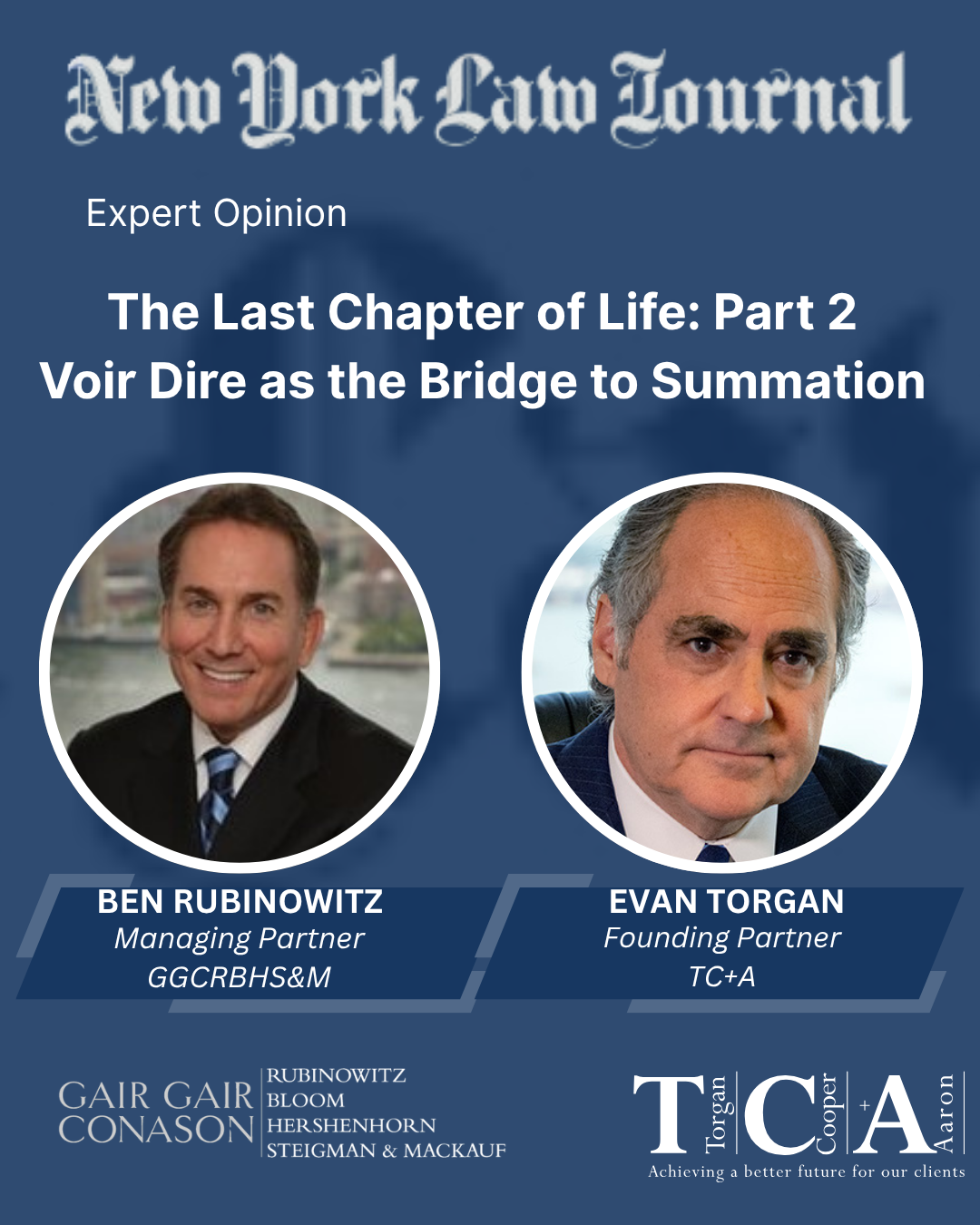 Gair Gair Conason Managing Partner Ben B. Rubinowitz, together with trial attorney Evan Torgan, examines an important challenge facing attorneys representing elderly injury victims in a newly published New York Law Journal column, “The Last Chapter of Life: Part 2—Voir Dire as the Bridge to Summation.”
The article focuses on what the authors describe as the “age discount”, the tendency for jurors to consciously or unconsciously view the injuries and suffering of an older plaintiff as less significant because that person may have fewer years remaining.
Rubinowitz and Torgan argue that trial lawyers should not wait until closing arguments to address this potential bias. Instead, they explain that the issue should be confronted during voir dire, when attorneys have their first opportunity to uncover jurors’ assumptions and attitudes about age.
As the authors write, voir dire provides the foundation for the argument that ultimately will be made in summation: an elderly plaintiff’s damages should be measured by what the injury actually took from that person, not simply by the number of years he or she might otherwise have been expected to live.
Identifying Age Bias During Jury Selection
One of the central lessons of the article is that age-related bias may never be stated openly unless attorneys create an environment in which prospective jurors feel comfortable discussing it.
Rather than simply asking whether someone is “biased against the elderly,” Rubinowitz and Torgan recommend asking questions that allow jurors to explore their beliefs about whether an injury to an 80- or 85-year-old person should be viewed differently from the same injury suffered by someone much younger.
The purpose is not to criticize prospective jurors, but to identify attitudes that could affect their ability to fairly evaluate damages. The authors emphasize that candid answers during jury selection can allow attorneys to address those beliefs before they quietly influence deliberations.
The Same Duty of Care Applies Regardless of Age
The column also emphasizes an important principle in personal injury litigation: a defendant does not owe an elderly person a lesser duty of care simply because that person is older or already has medical problems.
Rubinowitz and Torgan illustrate the point with a simple question for jurors: Does a driver approaching a crosswalk owe any less of a duty to an 86-year-old pedestrian than to a 22-year-old pedestrian walking next to her?
The answer, of course, should be no.
The authors also address the longstanding legal principle that a defendant generally takes an injured person as he or she is. Preexisting frailty or vulnerability does not automatically excuse a negligent defendant from responsibility for the additional harm caused by an accident.
Measuring What the Injury Actually Took Away
For elderly plaintiffs, some of the most significant consequences of a serious injury may not appear on an X-ray or medical bill.
Loss of independence, mobility and dignity can dramatically affect a person’s remaining years. An older person who previously lived independently may suddenly require assistance getting dressed, bathing, driving, shopping or simply leaving the house.
Rubinowitz and Torgan stress that these losses can fundamentally alter family relationships and a person’s sense of self. As they explain, dependence can change relationships built over a lifetime and create forms of suffering that cannot be measured through medical imaging alone.
Life Expectancy Should Not Define the Value of a Life
The article also examines how life-expectancy tables may be used in cases involving older plaintiffs.
Rather than allowing those statistics to dominate the damages discussion, the authors encourage attorneys to focus jurors on the quality and meaning of the time that was taken away.
A medical chart may record arthritis, hypertension or other diagnoses, but it does not capture a person’s routines, relationships, independence or everyday pleasures. Rubinowitz and Torgan argue that the proper inquiry is not simply how many years a plaintiff had remaining, but what the defendant’s negligence changed during those years.
Their central message is straightforward: a personal injury case involving an elderly plaintiff is ultimately about loss, not age. The value of that loss may be reflected in diminished independence, disrupted relationships, pain, fear and the inability to enjoy the activities that gave meaning to the plaintiff’s life.
Continuing a Discussion About Trial Advocacy and Elderly Plaintiffs
“The Last Chapter of Life: Part 2—Voir Dire as the Bridge to Summation” continues Rubinowitz and Torgan’s examination of trial strategy in cases involving elderly plaintiffs.
Ben B. Rubinowitz is the Managing Partner of Gair Gair Conason, Rubinowitz, Bloom, Hershenhorn, Steigman & Mackauf and is nationally recognized for his work in complex personal injury and medical malpractice litigation.
