Gair, Gair, Conason, Rubinowitz, Bloom, Hershenhorn, Steigman & Mackauf is a New York Plaintiff's personal injury law firm specializing in automobile accidents, construction accidents, medical malpractice, products liability, police misconduct and all types of New York personal injury litigation.

Articles Posted in Bicycle Accidents

Published on:

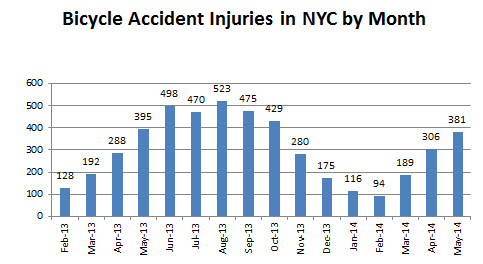
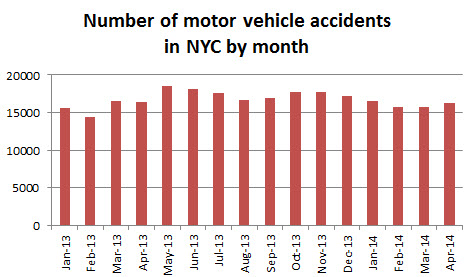
According to the recently released NYPD motor vehicle collisions report, there were a total of 16,265 motor vehicle accidents in New York City in April compared to 15,796 in March and 16,412 in April 2013. For the first four months of the year the total number of accidents in NYC increased to 64,341 compared to 62,850 in 2013.

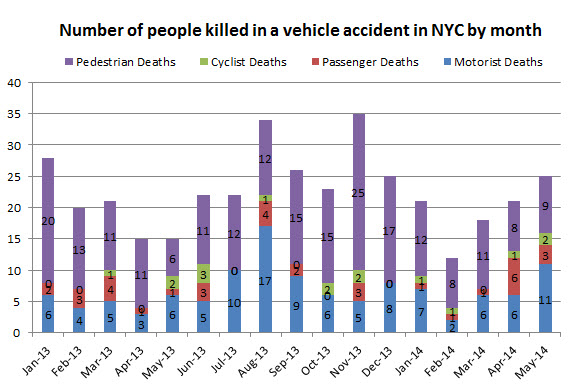
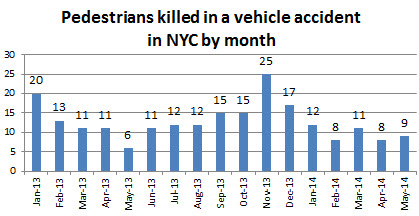
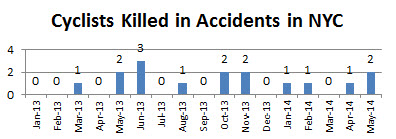
NYC%20motor%20vehicle%20accidents%20april%202014.jpgA total of 21 people died in traffic accidents in April compared to 15 in 2013.

Looking at the first 4 months of the year, the number of people dying in a crash is slightly lower in 2014 with 72 deaths compared to 84 deaths in 2013. For the last 3 months, this number is 51 in 2014 compared to 56 in 2013.

Published on:

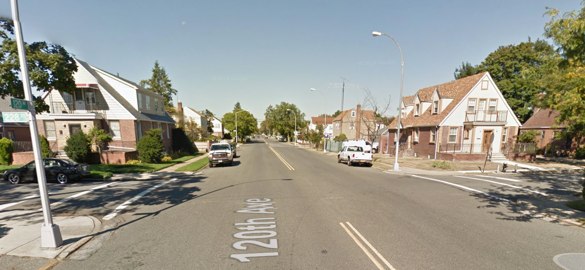
53 year old William Faison was riding his bicycle when he was struck and killed by a car at 228th Street and 120th Avenue in Cambria Heights, Queens, NYC. The car driver who killed him was reportedly driving with a suspended license and will likely get off with a slap on the wrist.

Read more in New York StreetBlog

Faison%20Bicycle%20Accident%20site.jpg
The site of the deadly bicycle accident, photo courtesy Google Map

Published on:

31 pedestrians, 10 bicyclists and 70 motor vehicle occupants suffered personal injury between 2007 and 2011 after they were involved in a traffic accident on Morningside Avenue between W 166th and W 126th street. Speeding is a main concern with 58% of northbound vehicles and 66% of southbound vehicles speeding according to a recent speed survey.

Last week after nine months of stalled deliberation, Community Board 10’s Transportation Committee accepted a proposal by the NYC Department of Transportation to make the dangerous corridor safer. The DOT proposed the reduction of four traffic lines to three on Morning Side Ave between 116th street and 126th street.

Read more in Street Blog

Published on:

Every year in New York and in the US, motorcycle operators and bicyclists are injured or die during crashes with a motorist. Sometimes the motorcyclist or the bicyclist are at fault and sometimes the accident is due to the motorist’s lack of attention. Here is an excellent video on how to share the road safely with motorcycles and bicycles.

Published on:

Vision Zero is asking pedestrians, bicyclists and motorists to pinpoint dangerous traffic areas in New York City on an interactive map that can be accessed online directly with an email address or through a Twitter or a Facebook account. Pedestrian crash corridors are highlighted in red on the map while all pedestrian fatalities that happened from 2009 till now are indicated by a red square. Unfortunately bicycle accident fatalities are missing on the map. New York road users can share, comment, agree on and pinpoint directly on the map the following type of traffic issues:

– Not enough time to cross – Double parking – Long wait to cross – Red light running – Jaywalking – Poor visibility – Speeding – Long distance to cross – Failure to yield – Cyclist behavior

It is a fantastic tool however there is a risk of distortion. The map was launched a few days ago and we can already see that high poverty areas are typically misrepresented. This can be due to language barriers, less access to technology or maybe less interest in current events. Hopefully Vision Zero workshops in these areas will be helpful in addressing this unbalance. The map shows big areas such as the West Bronx, East Brooklyn and Harlem with with very little activity compared to the rest of the city. Areas of the city where the youngest population live such as Downtown Manhattan and West Brooklyn are the most active areas on the map.

Published on:

Pedestrian%20fatality%20rate.pngToday we are looking at fatal pedestrian and bicycle accidents in New York and in the US.This is part 3 of of our series on the Walking and Bicycling Alliance 2014 Benchmarking report.

Globally since 1980, the pedestrian fatality rate and the bicyclist fatality rate have been decreasing significantly in the US. In 1980, 8070 pedestrians and 965 cyclists died on the road compared to respectively 4432 and 677 in 2011. However while the absolute numbers dropped, the percentage of pedestrian and cyclist fatalities among all traffic fatalities increase from 12.6% in 1980 to 15.8% in 2011.

Pedestrians and cyclists who are 65 and older have a much higher risk to be involved in a fatal accident. Seniors represent 10% of pedestrians and 6% of cyclists but account for 19% of the pedestrian fatalities and 12% of the cyclists fatalities.

Published on:

Numerous bicyclists and pedestrians have been severely injured and several of them have lost their lives in traffic crashes along Mc Guiness Blvd in Greenpoint, Brooklyn. The corridor nicknamed “Hipster Highway” is notorious for passenger vehicles and large trucks speeding. Two years ago a study by Transportation Alternatives showed that two thirds of cars and 62% of large trucks traveled over the 30 mph speed limit with a maximum speed reaching 50 mph for cars and 47 mph for big rigs.

Things should change and residents’ safety should improve by the end of this month as the 1.1 mile stretch of Mc Guiness Blvd between Bayard Street and Freeman Street will become the third arterial slow zone in New York City. New signage will be installed, traffic signals will be coordinated to reduce speeding and the NYPD will increase enforcement on the boulevard.

The creation of 25 arterial slow zones is part of the Zero Vision Action plan to reduce traffic fatalities in the city.

Published on:

This is part 2 of our series on the Walking and Bicycling Alliance 2014 Benchmarking report. Here are some figures we found interesting about pedestrians and bicyclists’ profiles.

Bicycle trips represent 1% of all trips taken in the US every year and walking trips 10.4%. While pedestrians are of all types of age, genders, income and ethnicity, bicyclists are mostly men and younger..

walk%20and%20bicycle%20trips%20by%20age.pngMost people walk or use their bike for a social or recreational reason however more and more people are using their bikes to go to work especially in large cities where the combined average share of commuters by bicycle and foot is significantly higher at nearly 6.1% (1.0% bicycling and 5.0% walking) compared to an average of 3.4% nationally.

Published on:

The BICYCLING AND WALKING IN THE UNITED STATES 2014 BENCHMARKING REPORT just came out. This report provides one of the most comprehensive reviews on bicycling and walking all over the US. It is compiled by the Alliance for Biking & Walking which is the North American coalition of over 220 state and local bicycling and walking advocacy organizations.

The Benchmarking report focuses on the 50 States and the 50 most populous American cities. Additionally and for the first time, 17 small and midsize cities were also added to the 2014 report to provide a more complete picture of biking and walking activities in the country.

Biking%20and%20walking%20study%20area.jpgGlobally the report shows a slow but steady increase of people using their bikes or their feet to go to work. The report also demonstrates that the level of pedestrian and bicycle accidents is inversely proportional to the number of bikers and walkers and that advocacy groups are playing an important role encouraging people to do so.