Gair, Gair, Conason, Rubinowitz, Bloom, Hershenhorn, Steigman & Mackauf is a New York Plaintiff's personal injury law firm specializing in automobile accidents, construction accidents, medical malpractice, products liability, police misconduct and all types of New York personal injury litigation.

Articles Posted in Construction Accident

Published on:

As the construction industry is booming again, immigrant construction workers are facing increased risks of exploitation. In a recent article in the Globe, Beth Healy and Megane Woolhouse investigate the practices of greedy contractors looking for cheap labor.

Immigrants sometimes very young are being hired illegally by contractors. They are paid cash below the minimum wage. They have no insurance. If they are injured on the job, they are often pressured not to report their injury.  15 year old Luis Mayancela fell two stories from a roof. He broke his leg. His contractor didn’t even called an ambulance. A co-worker drove him to the Emergency Room. After the accident, his boss denied all responsibility.

Because they are illegal, injured construction workers often fear retaliation and are pressured not to report their injuries. In their investigation, Healy and Woolhouse denounce industry practices that routinely exploit immigrant workers. Because many of them do not speak English well and are unfamiliar with their rights they often don’t even have a written agreement with their employers.
Published on:

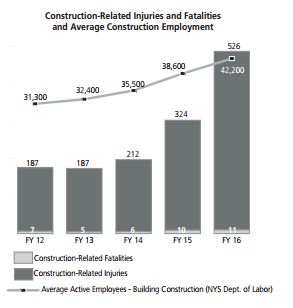
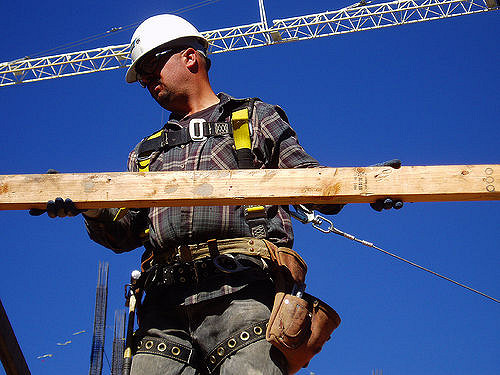
NYC Construction accident injuries and fatalitiesConstruction accident injuries in New York are on the rise as the city is experiencing a boom in this industry. The de Blasio administration just released the Mayor’s Management Report that covers the fiscal year that goes from July 2015 to the end of June 2016. The report indicates that 526 construction workers were injured and 11 died in construction accidents in New York City during the last fiscal year compared to respectively 324 and 10 during the previous fiscal year. During the same periods of time the average number of employees in the construction industry in NYC went from 38,600 to 42,200. While the workforce on construction sites only increased by 9%, the number of injuries increased by 62%.  The number of fatalities increased by 10%.

These statistics only reflect accidents injuries and deaths that occurred after a violations of the city’s construction code. The real number of deaths that occurred on New York City construction sites during that time is 18 according to OSHA statistics (see previous blog). Therefore the real number of injuries related to accidents on NYC construction sites may be much higher than 526, not only because the city’s manner of reporting injuries is biased but also because  many injuries are simply not reported. Construction workers  are often pressured not to report injuries by greedy contractors who don’t want to see their insurance increase or be investigated by OSHA or the DOT inspectors.

To try to make NYC construction sites safer, de Blasio announced new safety measures at the beginning of the year. Among the measures, new inspectors have been hired to increase the number of sites inspections. Penalties for violations of safety standards increased from $2,400 to $10,000 and penalties for not having a supervisor on site from $5,000 to $25,000. Additionally after a giant crane crashed on pedestrians in lower Manhattan, the city ordered a special study to update the city’s crane regulations.

Published on:

construction workerThe New York City Department of Buildings announced earlier this year that 12 people died in  construction accidents in New York City in 2015 but the real number is 18. According to a recent article in Crain’s, the New York City Department of Buildings only counts deaths that are related to a violation of the city’s construction code.
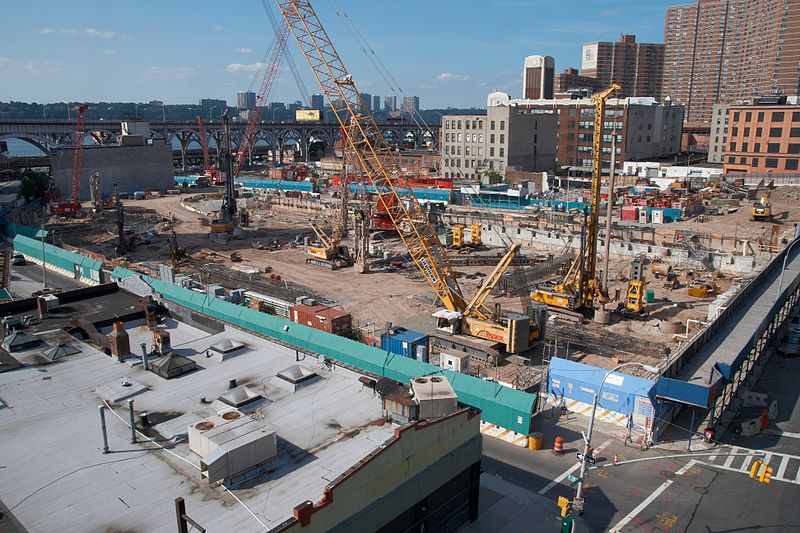
Despite being featured by media and investigated by OSHA, all other deaths on NYC construction sites are not counted as construction accident deaths  in the DOB statistics. This obviously doesn’t make much sense. The DOB numbers are a distorted indication of the level of safety on New York construction sites.

Among the deaths that the city didn’t count were a hard hat who fell to his death in an elevator shaft,  a safety coordinator crushed by a crane, a worker who fell from a ladder and a truck driver who was sucked into a concrete truck shaft. Following these deaths, OSHA issued safety violations for each case. However the DOB didn’t and also didn’t add them to the total number of New York City construction accident deaths in 2015.

Published on:

New York Construction SiteNew York has the sixth lowest construction worker injury rate in the U.S. according to the Bureau of Labor Statistics. Despite being among the safest cities for hard hats, working on a New York City construction site remains one of the riskiest occupations in the City.

According to “The price of Life, 2015 report on construction fatalities in NYC” released by The New York Committee for Occupational Safety and Health (NYCOSH), construction work accounts only for 4%  of employment but for 20% of occupational fatalities in New York State. As in the rest of the nation, falls to a lower level are the number one cause of death on New York construction sites. Almost half of the fatalities on NYC construction sites are related to falls from Heights.

Roofing and siding workers doing construction work at an elevation are the most at risk of a fatal fall.  These workers are often working in an unsafe environment. 80% of New York roofing and siding contractors who received a visit from an OSHA inspector between 2010 and 2012 received violations.

Published on:

construction sitePromoting safety culture not only reduces the risk of accidents at construction sites but also impacts other business aspects such as productivity and competitiveness. Large construction firms understand this concept and apply it in their day to day business while small construction firms are still lagging behind.
A recent survey by the Center for Construction Research and Training looks at the difference in safety culture and safety management between small and large companies.

Small firms with 1 to 9 employees represent a little more than 10% of the construction firms. Those with over 500 employees represent approximately 20% of them. Construction firms with 10 to 49 employees represent the biggest part, around 30% of construction firms.  Small firms usually work on low-rise commercial and residential projects while larger ones work on high rise and industrial projects.

Published on:

Hard HatTwo hard hats were severely injured in a construction accident in New York. The accident occurred this morning on a construction site located at 21 West 86th Street near Columbus Avenue on the Upper West Side. The two men were working on a door frame when it fell. The two workers lost their balance and fell 10 feet below into the basement below. After that an I-Beam fell on them. One of the men suffered a bad leg injury and the other one was also badly hurt. They were both transported to the hospital. A stop work order was issued at the site by the NYC Department of Buildings. From looking at photographs of the scene it is clear the there was no planking covering the hazardous opening as is required by The New York State Industrial Code to protect workers performing work in the area of the opening to prevent these types of accidents.

Read more in the NY Daily News

Picture: courtesy of Wikipedia

Published on:

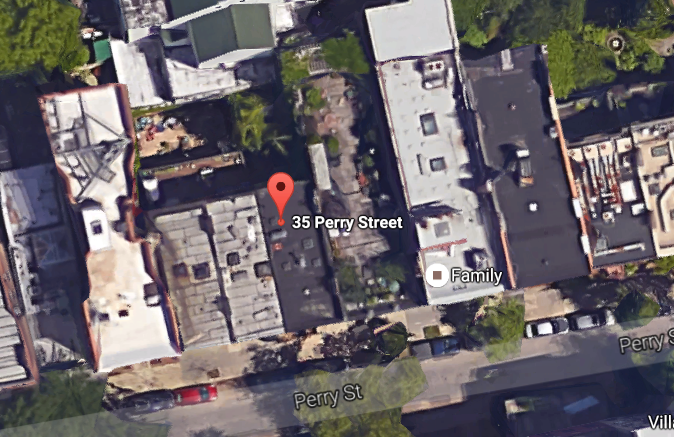
35 Perry Street aerialConstruction workers and residents living nearby a West Village townhouse in Manhattan were put at risk of a deadly collapse by a greedy homeowner. Inspectors from the New York City Department of Buildings who responded to a complaint at 35 Perry Street found a giant illegal excavation in the backyard. The excavation that was 7 feet deep in some areas was hidden by a fake grass carpet. The fake floor was suspended in a canopy style over the excavation. The owner, Joseph Ienco, had no construction permit. The excavation not only compromised the base of the 1,852 structure but also the foundation of 37 Perry Street. The owner put his workers and his neighbors at risk of a deadly construction accident. He was slapped with several safety violations. The inspectors also found illegal workers hiding in the house and a rental truck used to move debris out of the site.

Read more in the NY Daily News


Published on:

injured worker in construction accidentInjury data collection is getting modernized at the Occupational Safety and Health Administration (OSHA). A new rule was recently released in regard to workplace injury tracking. Effective January 1st 2017, the new rule requires some employers including those in high risk industries such as the construction industry to submit electronic records of injuries and illnesses.

For decades OSHA has been recording data related to injury and illness on the job.  Employers are required to record onsite injury and illnesses in specific forms often called the “OSHA Log”. The recording of injury and illness is an invaluable tool in detecting serious hazards on the work place and finding solutions to prevent them.

The new rule requiring electronic filing allow for a faster and more transparent reporting of injuries. Data will be released in standard open format. OSHA strongly believes that public disclosure will help “nudge” employers to focus on safety.  Additionally researchers will be able to use this data to find new ways to improve workplace safety.

Published on:

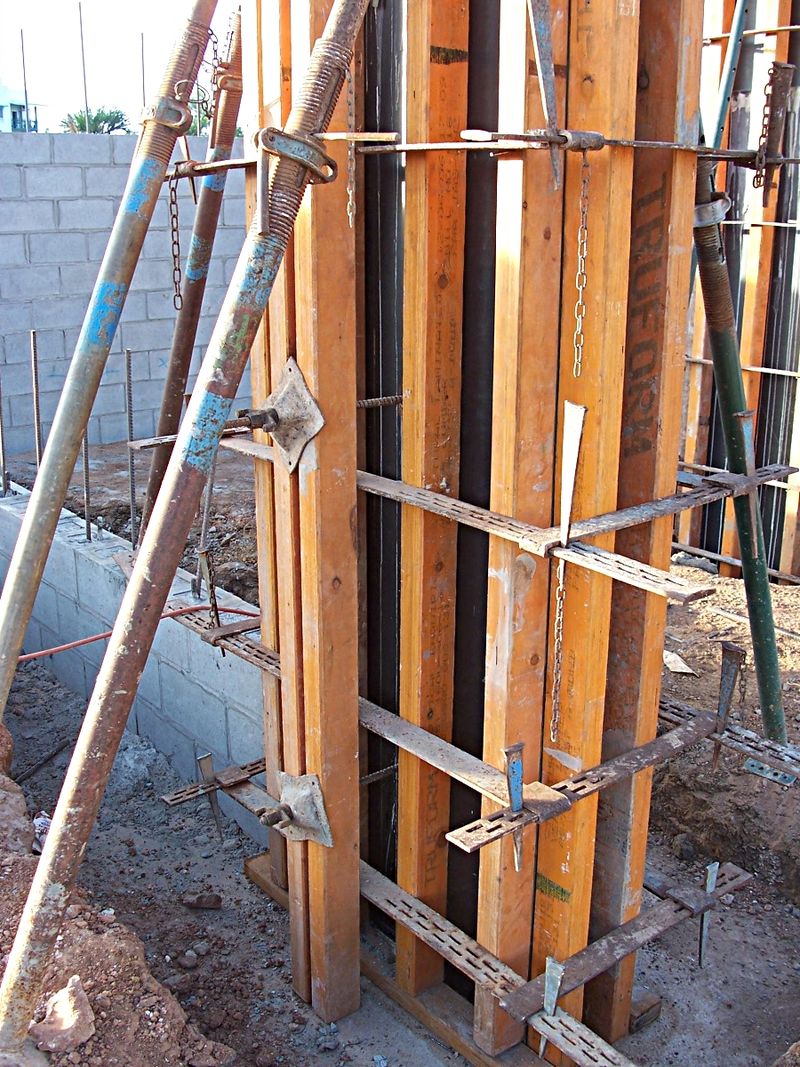
timber formwork The traditional way of building slab form work entails many risks of accidents and injuries to construction workers. The formwork is built on site, usually out of timber and plywood and concrete is poured into it. Several risks of accidents and injuries are associated with this operation such as:

  1. Serious injury or even death caused by a fall off the unprotected sides of the work zone’s leading edge.
  2. Serious injury caused by falling objects such as tools or material to workers  active below the area of the traditional formwork construction
Published on:

Three_World_Trade_Center_-_2015_renderThankfully nobody was injured in a New York crane accident last Thursday. Construction workers at the WTC site were pulling the unloaded line and hook of a crane standing on the top of a building under construction when the accident happened. The workers had been instructed to do so as a safety measure before a coming storm. A gust of wind sent a weighted ball attached to the crane’s line into a glass panel of the 3 World Trade Center building. Nobody was injured as the accident happened in the restricted perimeter of the WTC construction site.  John Gallager, the spokesman for  Tishman Construction said in a statement to the press that the glass window would be replaced and that the accident was being investigated.Read more in CBS New York

Wind and storms have been the cause of many crane accidents in New York City. Last February, David Wichs, who’s family is represented by our NYC crane accident attorney Howard  Hershenhorn, lost his life after the wind caused a giant crane to collapse on him. After the accident the city immediately increased mandatory safety measures for crane operators and created a special team to work on additional measures to prevent such accidents.

Picture: rendering of 3 World Trade Center courtesy of Wikipedia